

 Facebook
 Вход

 178


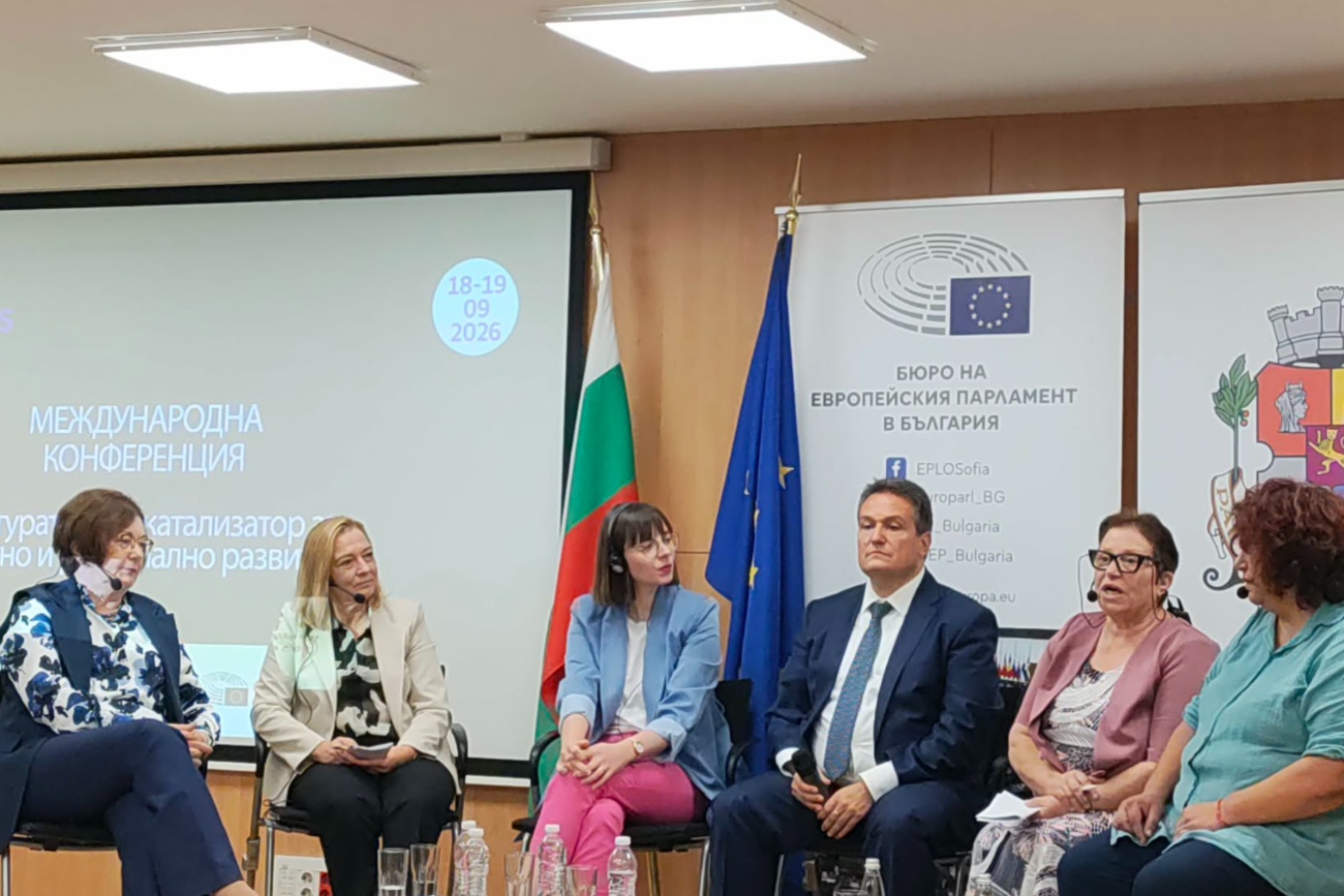
Community cultural centres and municipalities are not competitors, but natural partners with a shared objective: to provide access to high-quality cultural activities and build strong local communities. Participants united around this message at the international conference “Culture as a Catalyst for Local and Regional Development: From Local Partnerships to a Broader European Dimension”, held on 18 September at Europe House in Sofia.
The forum brought together representatives of local and national authorities, the European Parliament, the European Network of Cultural Centres (ENCC), Bulgarian community cultural centres—known as chitalishta—and cultural organisations. NAMRB was represented by Troyan Mayor and Deputy Chair of the Association’s Management Board Donka Mihaylova and Deputy Executive Director Teodora Dacheva, who took part in the discussion sessions.
The conference is the third in a series of six round-table discussions under the ENCC’s Bridge Makers programme. It was organised by the European Network of Cultural Centres and the Narodni Chitalishta Foundation, with financial support from Sofia Municipality and hosted by the European Parliament Liaison Office in Bulgaria.
At the opening of the forum, Sofia Deputy Mayor for Culture and Tourism Irina Dakova emphasised that culture extends far beyond major museums, galleries and festivals. It shapes the identity of a city, its sense of belonging and the connections between people. Community cultural centres often provide people with their first encounter with the arts—their first stage performance, concert or exhibition. They bring together different generations and social groups and therefore serve as both cultural and social infrastructure. Dakova added that Sofia Municipality’s Active Community Cultural Centres programme supports their work and explores the links between cultural decentralisation, access, building infrastructure and cultural content.
Tanya Chuntova of the European Parliament Liaison Office highlighted the European dimension of the subject, including access to culture in small and remote settlements, future European funding and the role of regions in connecting people.
Yuriy Valkovski, Executive Director of the Narodni Chitalishta Foundation, described the forum as a space for dialogue and the exchange of good practices, for placing Bulgaria’s experience in an international context and for establishing community cultural centres as key infrastructure not only for culture, but also for education, social activities, health awareness and digital literacy.
During the conference’s first panel, moderated by Yuriy Valkovski, Donka Mihaylova and Teodora Dacheva discussed relations between local authorities and community cultural centres, good practices and the difficulties that continue to limit the network’s potential. The discussion also involved Silvana Suleyman, Director of the Vidin Chitalishta Fund, and Neli Roydeva, Chair of the Community Cultural Centres with a Future – 2012 Association in Tundzha Municipality.
“A building is not a community cultural centre. The centre is the life that takes place within it,” said NAMRB Deputy Chair and Troyan Mayor Donka Mihaylova.
She presented the partnership between Troyan Municipality and its local community cultural centres as one of the community’s important achievements, built through continuous dialogue and a willingness to turn what has been heard into municipal policies. To address problems relating to the buildings, the Municipality has developed a long-term investment programme, clarified ownership, designed the necessary renovation works and scheduled their implementation over time.
Troyan Municipality also attracts funding through its Local Action Group and the Beautiful Bulgaria project, while ongoing activities are financed from the municipal budget. Additional support for initiatives by community cultural centres is provided through the Municipality’s cultural calendar and its Community Forum programme, under which residents participate in selecting the projects to receive funding.
Teodora Dacheva focused on the potential and development of community cultural centres. She described as concerning the tendency to view these centres, schools, personal development support centres and other local institutions as competitors, even though they all work for the same people.
“Community cultural centres and municipalities share a common goal—to provide people with an adequate cultural offering,” NAMRB’s Deputy Executive Director said.
She explained that the Bulgarian word for municipality, obshtina, derives from obshtnost, meaning community, while the community cultural centres themselves were established by local communities. Separating them from other local policies in culture, education, youth and social affairs therefore weakens the overall outcome. Dialogue is needed to distribute activities according to the experience and capacity of each organisation.
One of the main conclusions from the discussion was that the current funding mechanism has exhausted its potential and needs to be changed. NAMRB’s long-standing position is that the emphasis should be placed on actual activity and that community cultural centres which develop initiatives, work actively with their communities and attract additional resources should be encouraged.
Teodora Dacheva also informed the audience that during discussions earlier this week between NAMRB Management Board representatives, the Association’s team and the Minister of Culture, the parties considered establishing an expert working group. It would propose specific changes to the funding mechanism and options for maintaining and managing the buildings used by community cultural centres.
Donka Mihaylova compared the principle of funding subsidised staff positions with the “funding follows the student” model in education—a formal approach that does not in itself encourage quality. In her view, the quality of activities should become the leading criterion in determining the level of support.
Participants emphasised that the future model must also take account of the differences between large cities, small municipalities and settlements with declining populations.
NAMRB’s Deputy Executive Director also raised the need to expand the available sources of support. Possible options include dedicated National Culture Fund programmes for community cultural centres and access to Ministry of Education and Science programmes for extracurricular activities.
Participants from Vidin, Tundzha, Sliven, Varna and other municipalities supplemented the discussion with examples of local solutions and specific difficulties. These included insufficient working capital for participation in projects, the varying condition of buildings, the uneven distribution of subsidies and the need for training and systematic support.
The experience shared during the forum demonstrated that sustainable local associations and regular dialogue with municipalities can transform individual problems into a shared agenda and workable solutions.
The international conference launched a discussion that will continue through concrete expert work. The event runs on 18 and 19 September, and the organisers will subsequently publish further information summarising the discussions with the participating speakers.

png.png "За еврото")
png.png "КАМПАНИИ ПРОЕКТ УСПЕХ")


