

 Facebook
 Вход

 33


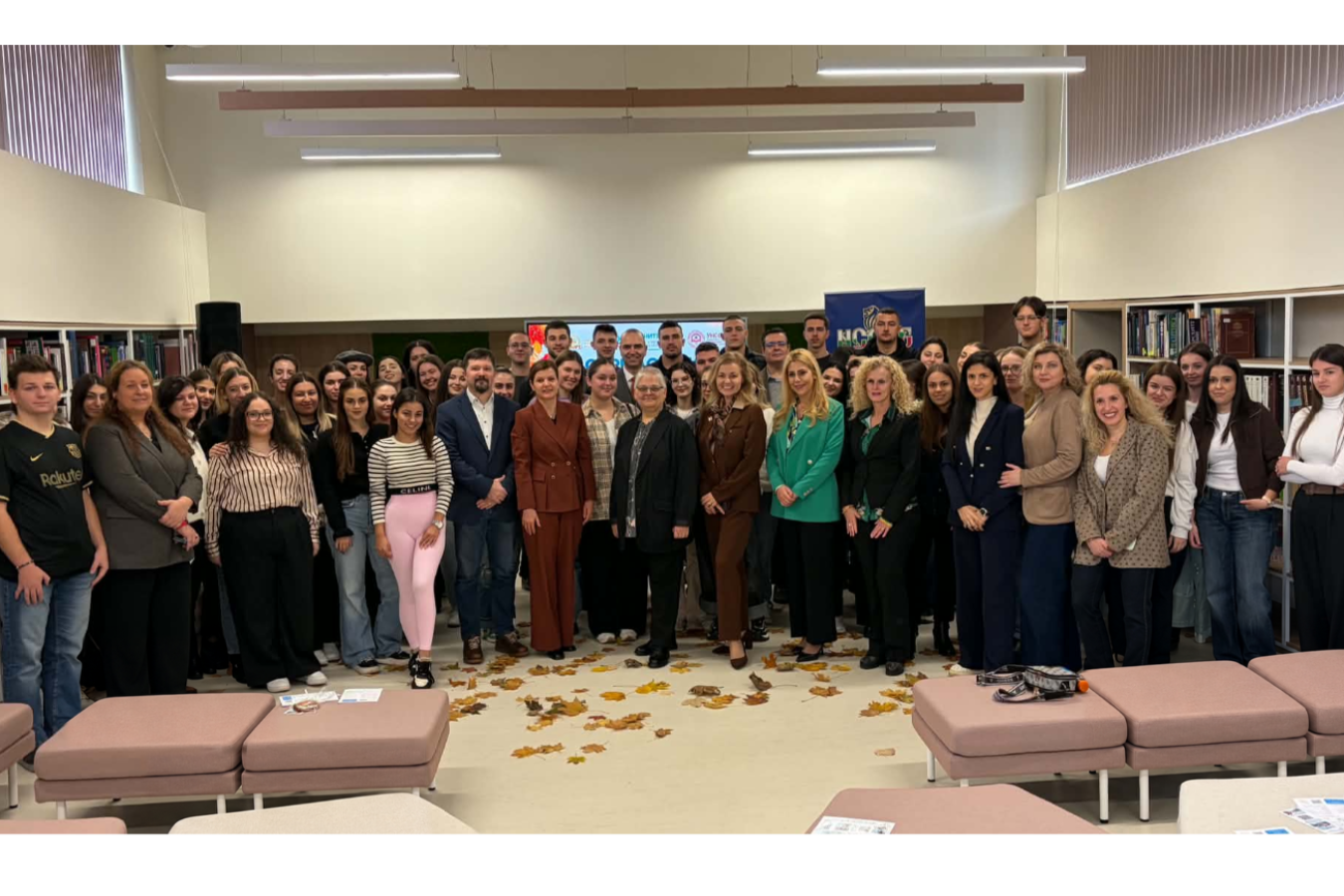
How technology is changing municipal services, what makes digital administration work, and how young people can contribute to this transformation were among the questions discussed at the 13th Autumn Academy, “Municipalities 2.0: Citizens and Local Government in the Digital Age”. The event took place on 9 November at the University of National and World Economy (UNWE), jointly organised by the university’s Department of Public Administration and the National Association of Municipalities in the Republic of Bulgaria (NAMRB).
NAMRB Executive Director Silvia Georgieva, Ognyan Atanasov, Mayor of Kyustendil Municipality, and Ivan Goychev, former Deputy Mayor of Sofia Municipality for Digitalisation, spoke with students about introducing new solutions, overcoming administrative obstacles and local government’s accountability to citizens.
The Academy was opened by Prof. Tsvetana Stoyanova, PhD, UNWE Vice-Rector for Institutional and Business Cooperation and Student Policies, and Assoc. Prof. Denitsa Gorchilova-Atanasova, PhD, Head of the Department of Public Administration. They highlighted the importance of bringing students together with practitioners to connect theoretical knowledge with the practical tasks facing public administration.
NAMRB Executive Director Silvia Georgieva placed citizens’ needs and the need for technological transformation to extend to municipalities’ internal working arrangements at the centre of the discussion. She explained that applying for a service online does not necessarily mean that the entire process is electronic. Behind a digital form, there are often still paper documents, manual information gathering and files moving between departments.
Efforts must therefore focus on connecting information systems, exchanging data with state registers and transforming internal administrative processes. She noted that solutions are more likely to be effective and user-friendly when citizens are involved in their development.
Georgieva presented NAMRB’s work to identify shared digital solutions, including artificial intelligence tools, that can be used by multiple municipalities. This approach is particularly important for small administrations with limited specialist capacity. She also highlighted the possibility of shared IT services across several municipalities to provide the necessary expertise and technical support.
The Association’s Executive Director stressed that new technologies can help prepare documents and perform repetitive tasks, but cannot replace human judgement when weighing different public needs. She highlighted the need for young professionals who understand digital processes, can work with data and combine this knowledge with communication and teamwork skills.
“Municipality 2.0 is not a municipality without people, but one where technology gives people more opportunities,” Silvia Georgieva concluded, encouraging students to consider local government as a career path.
Ognyan Atanasov, Mayor of Kyustendil, presented the municipality’s experience of using technology for citizen feedback, tourist information, administrative services and social support. He described the individual QR codes placed in municipal institutions and public spaces, enabling citizens to report problems and suggest improvements. The information reaches the Mayor’s Office directly and helps prompt specific action.
Another example was the digital guide to Kyustendil’s tourism opportunities developed by the municipal team. Through a QR code displayed at tourist attractions, hotels and restaurants, visitors can access information about sights, routes, accommodation and transport. Atanasov emphasised that municipalities can create useful solutions through their own teams and with modest financial resources.
The Mayor also presented the use of a geographic information system that allows users to check the designated land use of properties, alongside ongoing work to expand it with additional services. The administration already uses an artificial intelligence tool to analyse documents and case law in its legal and public procurement work. Electronic wristbands are also used in social support, enabling older people to request assistance when needed.
Atanasov also spoke about his personal involvement in communicating through Facebook, Instagram and TikTok. He explained that digital channels are complemented by regular meetings with residents in towns and villages, where problems are discussed and progress on commitments is reported. These conversations help determine priorities when needs exceed available funding.
“Our strength lies in our connection with people and the feedback we receive from them,” Mayor Ognyan Atanasov said. He encouraged students to gain experience in public administration and outlined opportunities to attract and develop young professionals within municipal teams.
Ivan Goychev examined digital transformation through data management, process organisation and changes to established working habits. He argued that a municipality has a fundamental responsibility to maintain reliable information and ensure equal treatment of citizens. Technology also enables this information to be used for more proactive service delivery—for example, notifying residents in advance about repairs to their street.
Drawing on Sofia Municipality’s experience, he described the introduction of tools for collaboration, electronic communication and staff coordination. Allowing several experts to work on the same document simultaneously makes cooperation easier between units located in different administrative buildings and reduces the time needed to circulate information. Goychev also highlighted the importance of competition when selecting technological solutions to secure better terms for the municipality.
Another example concerned the electronic signing of large numbers of documents. He stressed that automating repetitive actions frees up time for substantive management and specialist work. Achieving this, however, also requires a review of the rules governing document routing and approval. Otherwise, an electronically submitted application may simply be printed out and continue along the familiar paper-based route.
Goychev also discussed efforts to make municipal data openly available, including preparing rules for its use and discussing them with municipal councillors. Accessible data enables external developers, companies and students to propose applications and services, without the municipality having to develop every solution itself. In this context, he highlighted NAMRB’s role in bringing municipalities together around common challenges and sharing useful experience.
Ivan Goychev encouraged young people to demonstrate in practice how a task can be performed faster and better—a change that can also be initiated by an employee without a management role.
Students raised specific questions about unanswered reports, partially resolved problems, coordination between institutions and how to choose the first steps towards digitalisation. The discussion demonstrated how closely technological solutions are connected to internal rules, financial resources and municipal teams’ day-to-day work.
NAMRB reaffirmed its readiness to continue its partnerships with universities and involve young people in local government through internships, career opportunities and proposals to improve municipal services and the local environment. The Association thanked UNWE’s Department of Public Administration for its partnership an

png.png "За еврото")
png.png "КАМПАНИИ ПРОЕКТ УСПЕХ")


