

 Facebook
 Вход
Вход
 280
280


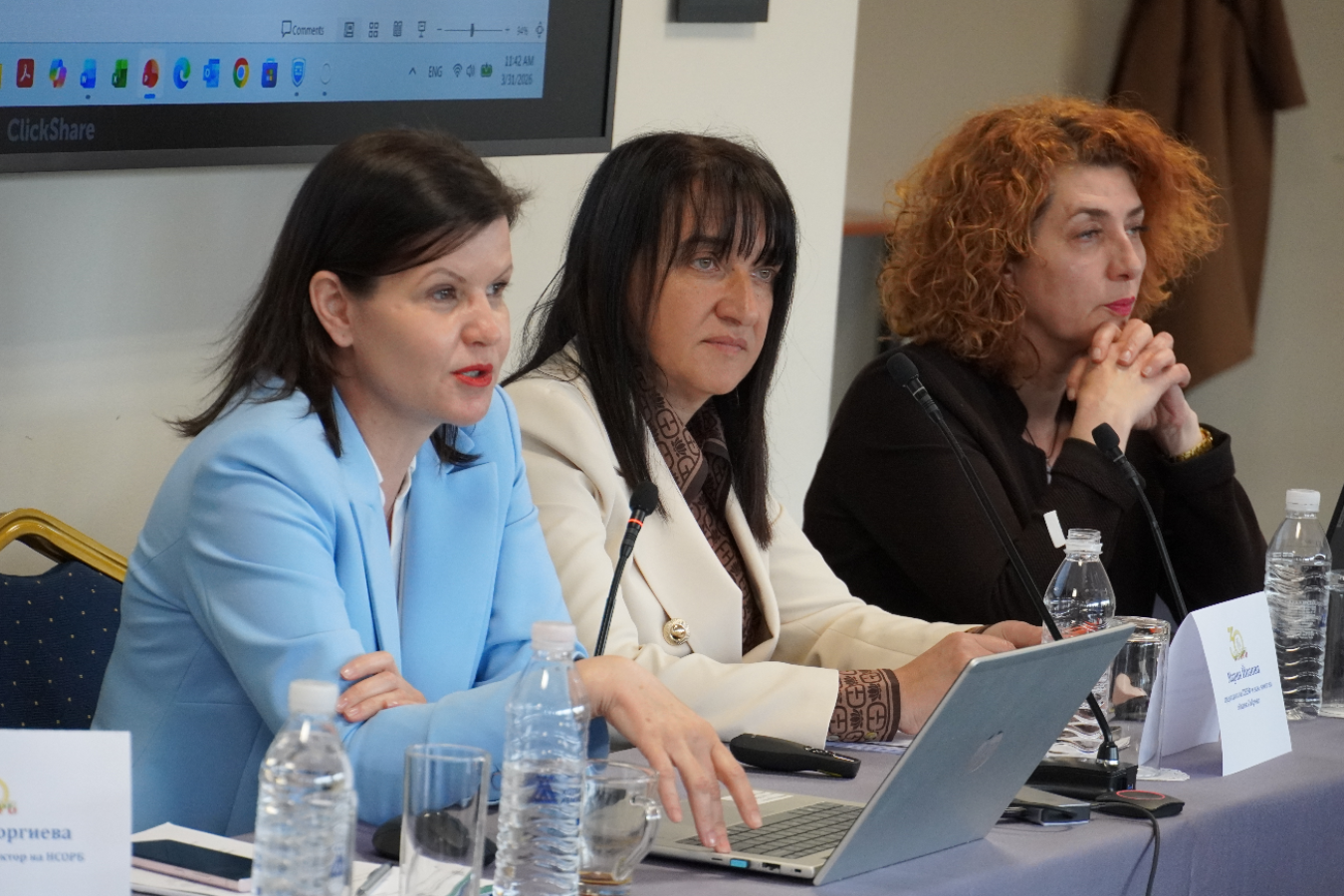
On 31 March 2026, the spring meeting of the Standing Committee on Budget and Finance (SCBF) of the National Association of Municipalities in the Republic of Bulgaria (NAMRB) was held in Sofia. Nearly 40 representatives from 22 municipalities took part, with almost all members actively contributing to the discussions.
A key focus of the meeting was the updated Law on the Collection of Revenues and the Execution of Expenditures pending the adoption of the State Budget Act for 2026. NAMRB Executive Director Silvia Georgieva presented in detail the municipal provisions included in the updated law, promulgated in issue 30 of the State Gazette, and highlighted their practical importance for the day-to-day functioning of local authorities.
“Municipalities cannot be put on hold in the absence of an adopted state budget, as they provide essential daily public services—cleanliness, street lighting, transport, social services, education, and winter maintenance,” Georgieva stated. She also warned that, due to the lack of a regular government, there is a real risk that the state budget may not be adopted in the near future, making it crucial for municipalities to fully understand the applicable interim framework.
The package of measures introduced—proposed by NAMRB and supported by Members of Parliament—includes provisions for temporary budgets, capital expenditure programs, management of carry-over balances, payments under EU-funded projects, and mechanisms for reallocating funds until the adoption of the regular budget law. Of particular importance is the newly introduced legal option allowing municipalities to incur expenditures for local policies when there is actual revenue from collected taxes and a decision of the municipal council. “This is not a free-for-all in spending, but a legal mechanism enabling municipalities to use available resources when there is a real need,” Georgieva emphasized.
An important practical step noted was the introduction of a mechanism to improve the predictability of capital expenditures—through monthly disbursement of targeted capital subsidies starting from 1 April, along with an obligation for municipal councils to adopt financing plans for capital programs. The Executive Director also highlighted NAMRB’s efforts in advocating for municipal proposals in parliamentary committees in close coordination with municipalities.
The Chair of the SCBF, Maria Yozova, emphasized the need for short-term amendments to the Local Taxes and Fees Act. Discussions covered the municipal waste fee, the tourist tax, and property tax valuations. The committee unanimously decided to establish itself as a working group to prepare specific legislative proposals concerning the municipal waste fee.
The discussion also addressed various approaches to improving the database of taxable properties, recommendations from the National Audit Office regarding property valuation, and issues related to lands under Article 19 of the Agricultural Land Ownership and Use Act.
Serious attention was given to the growing problem of motor vehicles registered to deceased persons that have not been re-registered in accordance with the Road Traffic Act and are not effectively recognized as assets of heirs. Challenges were also noted in collecting vehicle tax from foreign individuals and companies, particularly in border municipalities. Participants reported a significant increase in such cases across the country—in municipalities such as Montana, Gabrovo, Svishtov, and Blagoevgrad—creating both administrative and legal difficulties.
The need for coordination with the Ministry of Interior, the Traffic Police, and the Executive Agency “Automobile Administration” was discussed, including the possible introduction of a 2- or 3-year grace period followed by official deregistration in cases of non-payment of due taxes.
Attention was also drawn to the SCBF’s position on the case “Episode from Life: Purchase and Sale of a Motor Vehicle” and the requirement for a certificate of insurance value as an official document determining the transaction value. Participants noted that the current framework allows manipulation of declared values and agreed that the focus should remain on the tax base—the insurance value—until a more practical solution is found. A workable option discussed was to apply the higher of two values—the transaction price or the insurance value—for acquisition tax purposes, similar to real estate transactions.
At the invitation of the committee, Eng. Goranov presented the activities of the “Sofia SAT Club” and the potential use of satellite data in municipal governance. The club operates a network of small and medium satellite stations and data processing systems, with four stations currently active and ten more under development.
The collected data can be used for monitoring natural phenomena such as fires and floods, assessing risk conditions, and tracking urbanization processes in real time. The club brings together students and pupils interested in space and technology. A proposal was made to municipalities to launch small pilot projects involving the establishment of stations tailored to local needs.
Members of the SCBF also discussed the ongoing public consultation and the forthcoming entry into force of the National Spatial Development Concept (NSDC) 2026–2040, effective from 1 January 2027. The new regionalization aims to reduce territorial disparities and promote more balanced development, building on the 2013–2025 framework and addressing the green and digital transition, demographic pressures, and environmental sustainability.
The new NUTS 2 division includes four regions: the capital city as a separate region, and the remaining municipalities grouped into Northern, Eastern, and Southern regions. For municipalities, this means that local planning must be more closely aligned with investments in water and sanitation infrastructure, energy infrastructure, renewable energy, and resilience measures for settlements.
At the end of the meeting, Daniela Ushatova presented preliminary results from the analysis of local taxes and fees for 2026, covering data from 241 municipalities nationwide. Once finalized and approved by the NAMRB Board, the analysis will serve as a basis for future policy decisions and legislative proposals.

png.png "За еврото")
png.png "КАМПАНИИ ПРОЕКТ УСПЕХ")


