

 Facebook
 Вход

 835


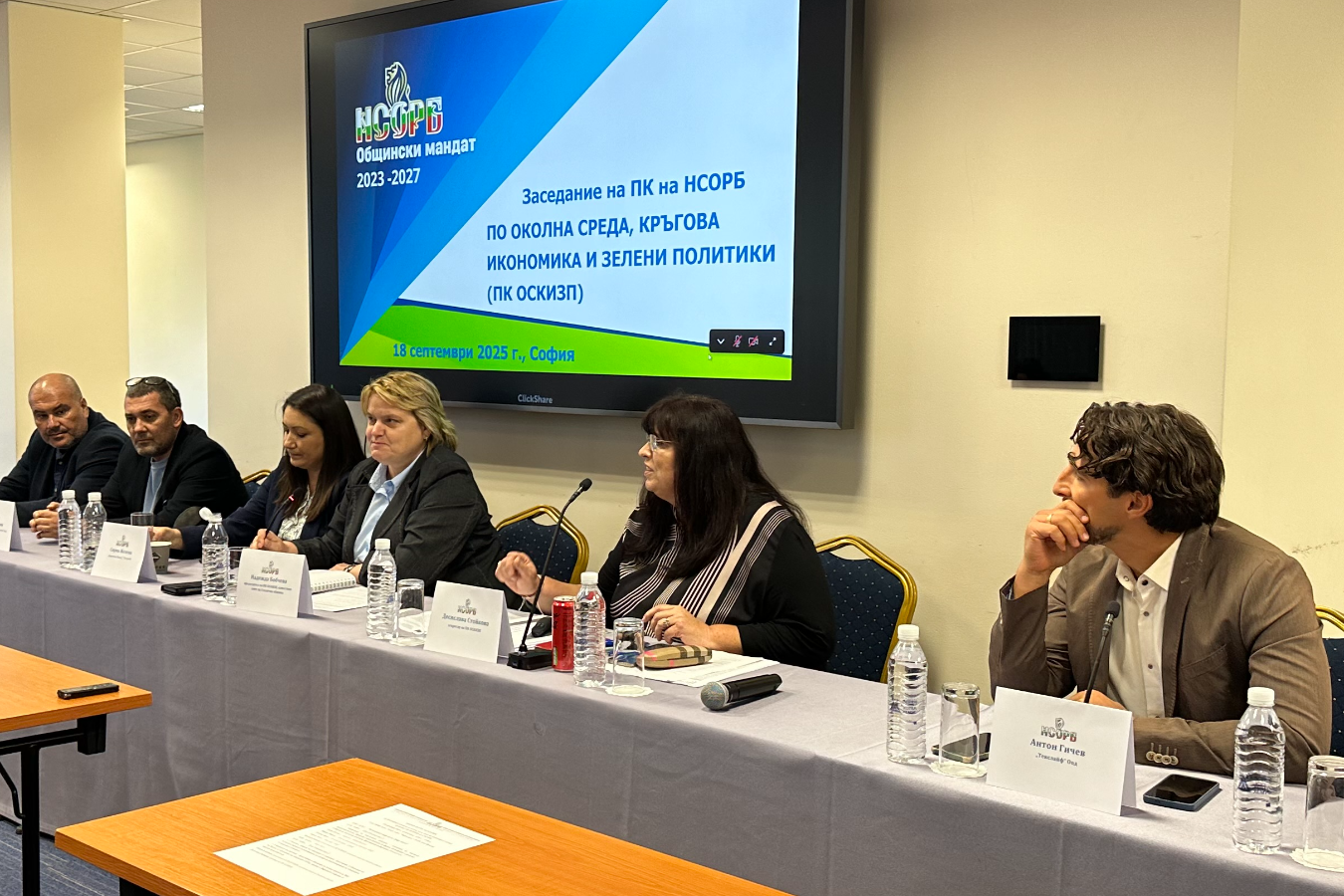
On September 18, 2025, a meeting of the Standing Committee on Environment, Circular Economy, and Green Policies (SCECEGP) at NSORB took place in Sofia. Key topics discussed included waste management, water management, and the development of green policies at both national and local levels.
The discussion was chaired by Nadezhda Bobcheva, Chair of the SCECEGP and Deputy Mayor of Sofia Municipality, together with the committee secretary, Desislava Stoykova.
In the first session, participants discussed the challenges of separate collection and recycling of textile waste. Although, as of January 1, 2025, all EU member states are required to ensure separate collection of textile waste, Bulgaria still lacks the practical conditions for its implementation.
Representatives from three textile waste treatment companies participated in the discussion: Sirma Zheleva from “Eurotex” Ltd. / TexCycle, Mariyan Ivanov and Tsvetomir Mihov from “M-Tex Textile Recycling” Ltd., and Anton Gichev from “Texlife” Ltd.
Secretary Desislava Stoykova recalled that the process of adapting national legislation to EU requirements began in 2018, but despite public and institutional expectations, the necessary Regulation on Textile Waste Management has not yet been adopted by the Ministry of Environment and Water (MOEW). Although the existing Waste Management Act clearly allocates responsibilities for textile waste, the absence of the regulation under Article 13(1) blocks the creation of sustainable systems for separate collection and treatment. Consequently, the lack of secondary legislation hinders the full implementation of the “polluter pays” principle, and funds from textile product producers are not yet collected. Companies have therefore requested municipalities to finance the costs of maintaining the system.
Sirma Zheleva from Eurotex Ltd. emphasized the need for clarity and action from MOEW, noting that the budget is insufficient and the amounts of waste are increasing. The solution must be short-term to avoid dismantling existing systems, citing examples where containers were removed in some municipalities, causing strong citizen reactions.
Mariyan Ivanov and Tsvetomir Mihov explained that their business models are at the edge of survival while awaiting the adoption of the new regulation. They warned that without textile and shoe recycling, thousands of tons will end up in landfills.
The companies also noted Bulgaria’s lack of competitiveness in supplying textile raw materials compared to Western countries and highlighted that the increase in waste is also driven by “fast fashion,” which produces more low-quality waste.
In response to these issues, NSORB sent a letter to MOEW on August 22, 2025, urging immediate action and answers to the following questions:
-
What are the specific deadlines and commitments of MOEW regarding the adoption of the Regulation on Textile and Footwear Waste Management? NSORB considers it necessary for MOEW to issue a public position and an updated timeline for the final adoption of the regulation and the steps for implementing the Extended Producer Responsibility (EPR) system in the textile sector, allowing municipalities, producers, retailers, and future recovery organizations to plan adequately and avoid administrative and financial risks.
-
What lawful actions can municipalities take during the transitional period before a functioning national system with recovery organizations is established? Municipalities need written guidance on the possibility of joint actions with private operators in the absence of legal status and transitional mechanisms for covering costs related to the collection and transportation of textile waste.
It is essential to emphasize that the lack of separate collection of textile waste directly impacts the municipal solid waste (MSW) fee. Textile, as part of mixed household waste, goes directly to landfills, resulting in:
-
increased transport and disposal costs;
-
disruption of mechanical sorting facilities due to textiles tangling in the equipment;
-
illegal burning or dumping, creating environmental risks and air pollution.
These consequences directly affect the required local waste management funding, increasing the financial burden on residents, since costs are included in the MSW fee, which contradicts the EPR principle established in EU and national legislation.
In the afternoon session, participants explored ways to improve municipal waste separation systems. Committee Chair Nadezhda Bobcheva summarized that, based on municipal proposals related to the draft Law on Amendments and Supplements to the Waste Management Act (published for public consultation in June 2025), three potential options were developed to improve the packaging waste recovery sector in municipalities:
Option 1: Maintain the status quo with regulatory enhancement of scope and infrastructure requirements. This option strengthens legal requirements for recovery organizations’ activities, proposing better territorial coverage: lowering the population coverage threshold (e.g., from 5,000 to 1,000 residents); ensuring more collection containers and service frequency; stricter control by MOEW and municipalities over actual contract compliance by recovery organizations.
Option 2: Joint implementation with guaranteed funding based on services performed. Building on Option 1, this introduces a fair and legal mechanism to financially compensate municipalities for activities they perform—collection, transport, and temporary storage of packaging waste. Funding is based on activities and actual volumes.
Option 3: Direct participation of municipalities as operators. In this option, municipalities (or their associations) register as recovery organizations and manage their own systems for collection, recovery, and recycling of packaging waste, with full access to product fees. This includes the right to build and operate independent systems, assuming full administrative, financial, and operational responsibility for activities and achieving regulatory objectives in their territory.
In the final part of the meeting, members exchanged ideas on proposed amendments to the Water Act, including river management in Sofia, and reviewed information on the current state of the Social Climate Plan.
Additionally, the document “Proposal for National Implementation of the Transition Scheme to Alternative Household Heating Systems” was presented, prepared under Activity C7 of the Integrated Project “Bulgarian Municipalities Working Together to Improve Air Quality” under the EU LIFE Program (LIFE17 IPE/BG/000012 - LIFE IP CLEAN AIR). The project addresses PM10 air quality issues caused by household heating with wood and coal in six Bulgarian municipalities (Sofia, Burgas, Ruse, Stara Zagora, Veliko Tarnovo, and Montana). Actions include replacing old heating devices with ecological alternatives, aiming to reduce PM10 emissions by 154 tons per year.
The SCECEGP meeting highlighted the challenges faced by municipalities and businesses in building a sustainable waste management system and implementing green policies.

png.png "За еврото")
png.png "КАМПАНИИ ПРОЕКТ УСПЕХ")


