

 Facebook
 Вход

 726


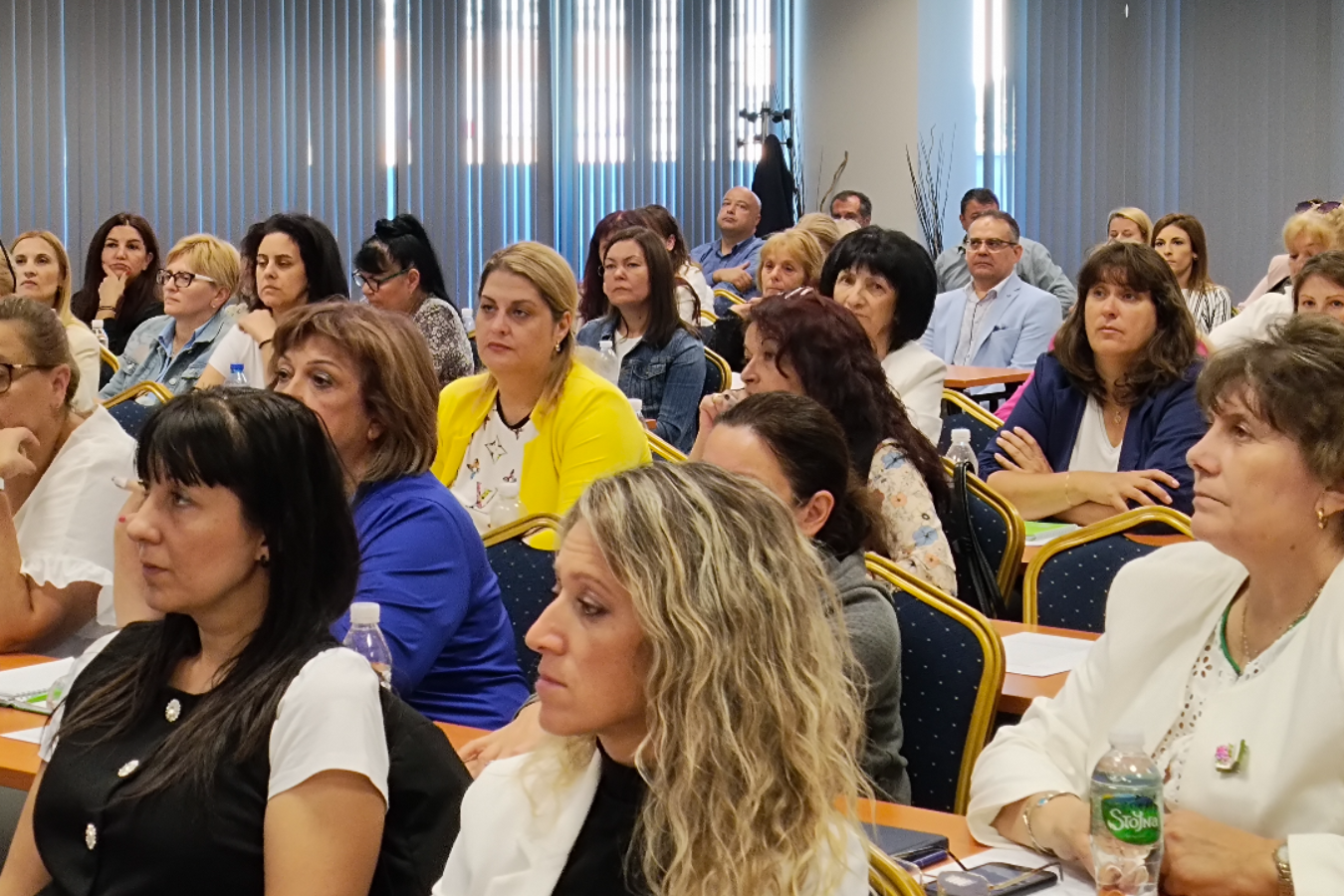
Effective discussion of the permanent commission on demographic and social policies at NSORB. With exceptionally high participation, the autumn meeting of the Permanent Commission on Demographic and Social Policies at NSORB took place on September 24 in Sofia.
The meeting, attended by over 80 representatives of municipalities and guests – including representatives from the Ministry of Labor and Social Policy and the Social Assistance Agency – was opened by Rositsa Dimitrova, co-chair of the Permanent Commission on Demographic and Social Policies at NSORB and Director of the “Social Activities and Healthcare” Directorate in Veliko Tarnovo Municipality. She thanked her colleagues for their strong presence and interest in the agenda topics. “A full room once again shows that we are responsible people, professionals who care about planning, organizing, and delivering social services at the local level and being satisfied with the results of our work. People who are dedicated, unafraid, and willing to face the challenges of implementing the Social Services Act, who will not abandon this path because it will bring more satisfaction and benefit to people in our municipalities,” she said. Dimitrova emphasized that over the past five years, municipalities have accumulated significant practical experience, which varies in each municipality regarding the integration of personal assistance services for the benefit of users with other existing social services supporting people with disabilities, in line with the shared priority: “The longer, the better. The more accessible, the higher quality. The more integrated, the more beneficial. People with disabilities should remain in their home environment as long as possible,” added the co-chair. She introduced the guests participating in the meeting for each topic and stressed the importance of collaborative work.
The one-day meeting in Sofia began with an active discussion on open issues related to the administration of the personal assistance mechanism.
Eleonora Pachejieva, Director of the “Policy for People with Disabilities, Equal Opportunities and Social Assistance” Directorate at the Ministry of Labor and Social Policy, thanked NSORB and the municipalities for their connection and communication throughout the work process. She noted that they rely on daily feedback from municipalities as well as regular meetings. This helps in finding solutions and providing useful examples to other municipalities seeking assistance with existing cases. Pachejieva also presented statistical data showing the current situation in social services, measured in terms of funding and growth trends. “The data you see shows a clear trend towards prioritizing services provided directly in the community and at home, with personal assistance receiving significantly increased resources, reflecting the policy of more individualized support and the lack of restrictions on the number of users,” said the director. She added that the main trends indicate a significant overall increase in funding for social services and personal assistance. The total budget for social services and personal assistance increased by 23% – from BGN 1.794 billion to BGN 2.209 billion. Funding for personal assistance recorded the largest growth of 30%, rising from BGN 891.3 million to BGN 1.157 billion. “The personal assistance mechanism is based on a medical disability certificate, assessment of needs, and besides covering assistant salaries, we annually increase the number of beneficiaries.”
During the discussion, representatives from various municipalities asked questions and shared examples of challenges in their work. The co-chairs Rositsa Dimitrova and Veselina Boteva, Director of the “Social Policy” Directorate in Plovdiv Municipality, and Daniela Ushatova, Secretary of the Commission and head of the “Local Policies and Finance” team at NSORB, shared several proposals from the Association, including:
-
Reviewing the current requirement for a formal employment contract between the personal assistance provider and the assistant, allowing differentiation in cases where another type of contract could be used (different from the standard employment contract). Overcoming existing legal restrictions regarding working hours under employment contracts and issues related to social security information for assistants providing fewer support hours.
-
Optimizing the preparation of individual assessments of people with disabilities, including a special component in the conclusions under Art. 23, para. 3 of the Social Services Act, and establishing a mechanism for joint notification and use of other types of community-based services.
-
Reducing paperwork and specific deadlines applied at different stages of the personal assistance mechanism (inclusion, provision, control) – applications, agreements, reports, contracts, etc.
-
Optimizing and fully digitizing the interaction between responsible authorities (Medical Expertise Commission, Social Assistance Agency, National Social Security Institute, municipalities) in implementing and financing the personal assistance mechanism.
All participants noted the good communication between NSORB and the Ministry of Labor and Social Policy on these issues and the shared goal: to ensure that people with disabilities receive quality support through personal assistance and can actively participate in society – within their families, workplaces, and communities.
Challenges were shared regarding compliance with short legal deadlines for submitting monthly reports for larger numbers of beneficiaries and different types of data checks that could be automated. Different views were expressed regarding the educational level of assistants. Financial aspects, salaries, working hours, contracts, and leaves were also discussed. Concerns about monitoring, particularly with many users, were raised, including difficulties in aligning inspections with the working hours of administration or assistants.
The general discussion highlighted that all municipalities – small, medium, and large – face different situations and problems, but it is essential to have enough staff to perform this work.
“Personal assistance means being integrated, more independent, empowered, and included, not excluded. Whether we have enough will to conduct a truly objective analysis, assessing the pros and cons of our personal assistants and whether the will exists to organize things properly,” Dimitrova emotionally shared.
“I am very happy that we are working in the same direction, and I am extremely pleased with today’s meeting!” said Elena Pachejieva.
The topic of making “Assistant support” more accessible and of higher quality was discussed by Teodora Lyubenova, state expert in the “Social Inclusion Policies, Children and Family” unit of the “Social Inclusion” Directorate, and Iliyan Saraliev, Head of the “Social Inclusion Programs” unit of the same directorate at the Ministry. By 2025, 263 Bulgarian municipalities provide the “Assistant support” service. Rositsa Dimitrova and Veselina Boteva encouraged colleagues to ask questions and share any difficulties. Key challenges and priorities discussed included expanding the target group, increasing financial resources according to state funding standards, ensuring comprehensive and continuous care for those in need, and exploring ideas for providing higher-quality support efficiently, including integration with other social or healthcare services. A significant part of the discussion focused on medical disability certificates (TELK) and the inability of people with disabilities without external assistance to access assistant support under the Social Services Act. Dimitrova stressed: “We are responsible for the life and health of the user and must speak honestly and ensure our voice is heard.” The co-chair thanked Ministry representatives for consistently supporting municipalities. They confirmed that all issues raised would be analyzed to find the best solutions.
Members of the commission reviewed practices and questions regarding the application of the Social Services Act and its sub-legislation for 2026. Current issues related to the reform of the social services system were discussed. Alongside Lyubenova and Saraliev, representatives of the Social Assistance Agency, Miglena Hitova and Borislav Mikov, participated. Numerous questions and answers focused on reform progress, the application of new regulations, and financing opportunities for social services in 2026.
Agency and Ministry representatives also addressed questions related to the Integrated Information System – Social Services Module. Municipalities suggested automatic fields to facilitate work. Borislav Mikov reminded that all municipalities received a guide for using the module and had a test period. Plans were to be submitted by August 31, 2025, which most municipalities complied with; the final deadline for uploading information to the system is September 30. Changes between the two dates can be uploaded as proof in the system if there are financial adjustments.
Miglena Hitova reminded municipalities that all requests for compensated changes must be submitted by October 1, 2025, due to budget procedures. Requests submitted later will not be considered until the adoption of the new State Budget Act for 2026.
The issue of transitional balances in social services, their causes, and spending requirements under the Social Services Act and State Budget Act were discussed.
Iliyan Saraliev reminded municipalities that the remaining months are critical for social infrastructure financed under the unprecedented resources of the National Recovery and Resilience Plan. “If you don’t select a contractor for construction and repair activities by the end of the year, we will not receive funding. Even if a contract is signed on December 24, there will not be enough time to complete the project within six months.”
“The goal of every service is to bring improvement in the condition of the end user. If there is no such improvement, no matter how much effort or money we have invested, our work becomes meaningless,” shared Saraliev.
Rositsa Dimitrova emphasized that municipalities strive to learn from mistakes and avoid harmful practices. “We try to ensure services truly benefit people,” she said, adding that resources should be targeted – where needed, when needed – and not limited by unnecessary barriers like disability certificates or external assistance requirements.
Commission members also discussed the lack of financial resources and a model for transitioning to entirely new funding standards for social services. In this regard, municipalities’ referral of citizens to social services, according to the Social Services Act’s implementing regulation, will only begin after the adoption of new financial standards.
Participants also received information on support for municipalities under the Human Resources Development Program 2021–2027. Updates were presented on the implementation of projects under the “Innovative health and social services” procedure and future support opportunities under the “Promoting the social economy at local and regional level” procedure by Maria Zhelezarova, Head of “Verification” Department, and Tashka Gabrovska, state expert in “Programming and Contracting” at the Ministry. Representatives of the program noted that 113 municipalities have requested so-called “Telecare” support under activity 2 of the “Innovative health and social services” procedure, but none have yet submitted activity reports or feedback.
During the meeting, representatives of the Trust for Social Achievement presented their new initiative and service “Together – Healthy Baby, Healthy Future,” currently offered in Sofia and Plovdiv, and a discussion was held on promoting and expanding it to other municipalities.
At the end of the meeting, participants also discussed the key upcoming deadlines and activities related to the introduction of the euro.
The highly productive meeting concluded with participants and guests expressing satisfaction and a commitment to continue the established partnership to solve problems and achieve the main goals.

png.png "За еврото")
png.png "КАМПАНИИ ПРОЕКТ УСПЕХ")


